
Cask-It Journal
The Whisky Loch Is Not a Clearance Sale
The whisky loch does not mean every Scotch bottle is cheaper. Understand the downturn, auction prices and what to check before buying whisky or booking a tour.
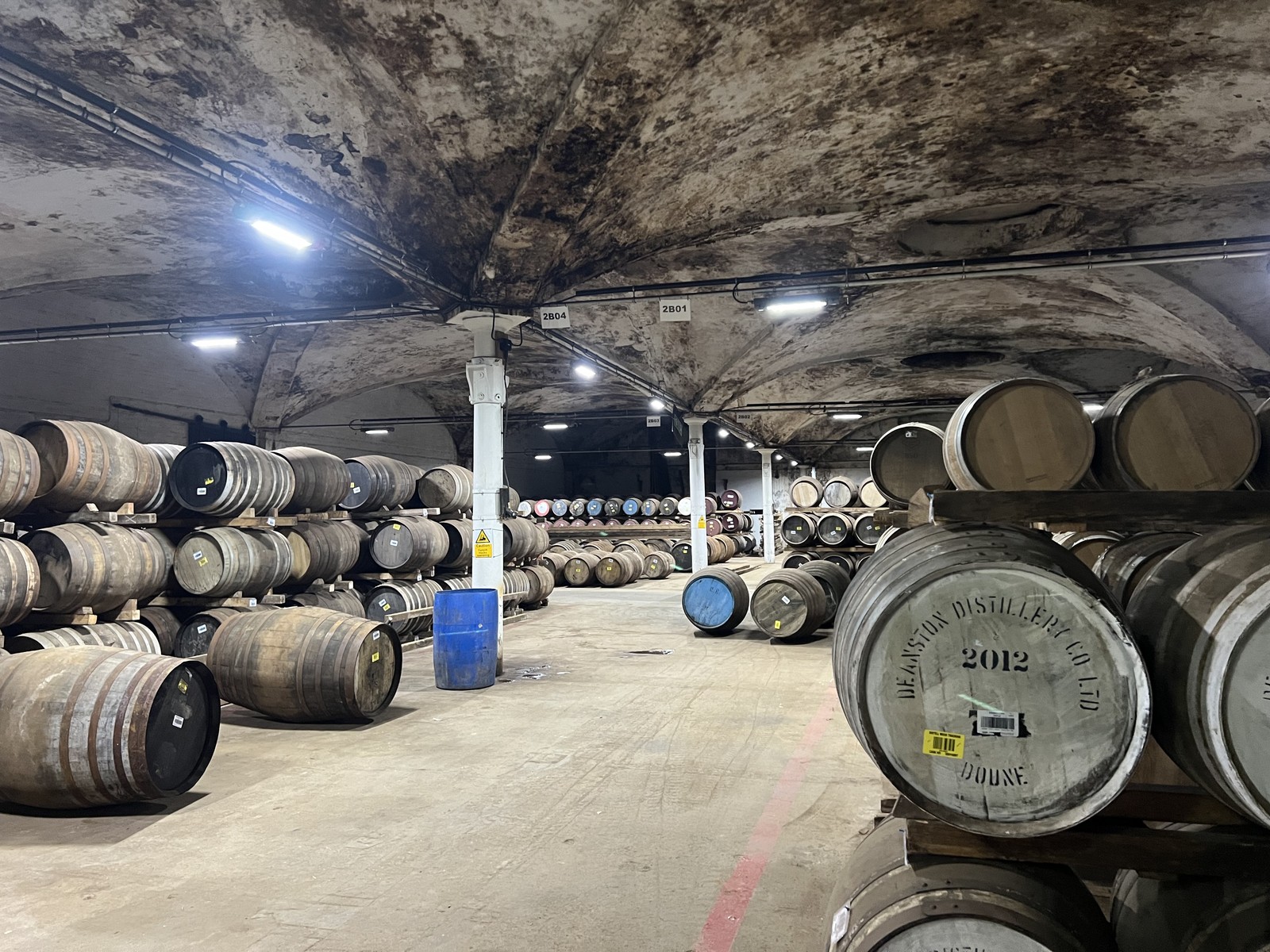
Casks in Deanston Distillery’s vaulted warehouse. Cask-It family photograph. Shown as an example of maturing stock, not as evidence of surplus at Deanston.
Facts checked 13 November 2026.
A warehouse full of whisky is not a shelf full of bargains. That is the missing detail in the latest Scotch downturn headlines.
The “whisky loch” describes whisky accumulating beyond demand. Falling exports, production cuts and weaker collectible prices explain why the term has returned. But they do not tell you that every bottle of Scotch is cheaper, or that a distillery has stopped welcoming visitors.
For a drinker, the useful question is simple: what changes about the bottle you buy or the trip you book?
Start by separating the whisky in a warehouse, the whisky sold at auction and the whisky on a shop shelf. They belong to the same industry. They are not the same market.
What is the whisky loch?
The whisky loch is a nickname for an oversupply of Scotch whisky. It became associated with the stock build-up and distillery shutdowns of the 1980s.
Whisky writer Iain Russell traces the problem further back. Production during the 1960s and early 1970s ran ahead of later demand. Spirit laid down when sales looked strong eventually became stock that was harder to sell. His history explains how the surplus developed.
That delay is central to the story. The Scotch Whisky Association confirms that Scotch must mature in oak casks for at least three years. Many expressions mature much longer. A producer cannot decide this autumn how much 15-year-old whisky to make for next Christmas. The SWA explains the maturation requirement.
Distillers commit money, space and production long before they know the eventual market. If demand weakens, the whisky already in the cask does not disappear.
Russell records DCL shutting eleven of its 45 malt distilleries in 1983, including Port Ellen and Brora. Those were DCL's malt sites, not a count of every closure across Scotland. His broader account describes dozens of distilleries being mothballed or closed.
That history gives today's headlines their force. Jobs, businesses and communities are at stake. It does not prove that the present downturn will follow the same path.
Are there really 12 billion unsold bottles of Scotch?
Not in the sense that the headline suggests. The SWA reports some 22 million casks maturing in Scottish warehouses, equivalent to around 12 billion 70cl bottles. That is maturing inventory expressed as bottle equivalents. These are the industry's published stock figures.
It is not a count of finished bottles waiting in boxes. Nor is it a measurement showing that all those casks are excess stock.
Scotch needs inventory to exist. A bottle with an age statement depends on whisky laid down years earlier. Producers must hold stock for future releases as well as meet current orders.
A glut is the part that runs ahead of demand, not every cask in Scotland. The published total does not tell us how much November 2026 stock is surplus, its age mix or which expressions it might become.
That is why dividing 12 billion by a year's sales will not tell you when the “loch” will drain. Warehouse inventory and export shipments are different measures. They also cover different stages of whisky's life.
The total tells us that Scotland holds a vast amount of maturing spirit. It does not tell us that your preferred 18-year-old is about to be discounted.
What do the Scotch downturn numbers actually show?
They show pressure, but the reporting periods matter.
The SWA's revised figures say Scotch export volume fell 4.3% in calendar-year 2025 compared with 2024. Volume totalled 1.34 billion 70cl bottle equivalents. Export value fell 1.8%, reported as £5.3 billion. Use the revised SWA export release for those comparisons.
The 4.3% figure is a volume decline. It is not a fall in the price of a bottle at your local shop. These are 2025 export results published in 2026, not a completed picture of 2026 trading.
Company accounts give another view. Whyte and Mackay Group Limited's consolidated operating profit fell by 51%, to £39.6 million, for the year ended 31 December 2025. It had been £80.0 million in 2024. Those are reported profits after exceptional items. The group accounts are filed at Companies House.
The group described a significant slowdown in the global whisky market. That is management's explanation of its trading conditions, not evidence that every producer suffered the same decline.
Production reports need dates too. The Spirits Business reported 30% annual production reductions at Glengoyne and Rosebank in July 2026. Its report discussed Ian Macleod's accounting year ended 30 September 2025. It was not a fresh November announcement or proof of either site's current operating rate. The reporting period is stated in the original article.
The clearest recent example of a business entering administration is GlenWyvis. Joint administrators were appointed on 5 October 2026. Interpath's notice the next day said there would be no further gin or whisky distilling. Three staff members had been made redundant. The administrator's announcement gives the details.
These are serious developments. They should not be flattened into one claim that every distillery is closing or every bottle is losing value.
Why does a 42% auction decline not mean cheaper Scotch everywhere?
Because the index tracks collectible bottles, not ordinary retail Scotch.
MoneyWeek reported on 1 November 2026 that the Rare Whisky 101 Icon 100 index had fallen 42% from its May 2022 peak. The article placed its post-pandemic low in the previous month. That is the reported collectible-market comparison.
Rare Whisky 101 defines Icon 100 as 100 iconic collectors' bottles regularly traded at UK auctions. The index provider explains its scope.
A discontinued collector's bottle at auction and a current-release bottle in a whisky shop can behave differently. One may be sought for rarity or resale. The other may be bought to open with friends.
Even within the index, an overall fall does not mean each constituent bottle fell by the same percentage. It certainly does not turn into a 42% reduction across supermarket shelves.
If you collect whisky, research the exact release. Recent completed sales are more useful than an optimistic asking price. Check condition, provenance and the auction house's charges before comparing results.
If you buy whisky to drink, focus on the current bottle, its specification and its delivered price. An auction-market headline is not a substitute for that comparison.
Why might retail prices stay high during a surplus?
A retail bottle carries costs beyond the whisky inside it. Tax is one reason an industry downturn does not translate neatly into a shelf-price cut.
The SWA's October 2026 Budget response said the announced increase would take tax on an average-priced UK bottle of Scotch to 74%, from 72%. That figure combines VAT and excise duty. It does not describe the tax share of all industry revenue or Scotch sold overseas. The SWA sets out its estimate here.
The timing matters. HMRC says the new rates take effect on 1 February 2027. As of this article's check date, 74% is a projected post-increase share, not a universal rate already in force. The effective date is stated by HMRC.
For an American reader, a UK shelf price also needs its own context. Bottle size, local taxes and the price in your market can differ. Do not assume a British price is a like-for-like comparison with the bottle near you.
A stock total cannot tell you which retailer will run a promotion or when a brand will change its price. A downturn may create offers. The evidence here does not establish a general retail-price fall or a timetable for one.
What should you check before buying a bottle?
Buy the bottle you want at a price you have actually checked. Do not buy a warehouse headline.
First, identify the exact expression. An age statement, cask-strength edition, discontinued release and standard bottling are not interchangeable. If the label is unfamiliar, use our guide to reading a Scotch whisky label.
Second, compare bottle sizes. Consider a simple illustration, not a current retail offer: a 70cl bottle at £50 costs £71.43 per litre. A one-litre bottle at £65 costs £65 per litre. The higher ticket price buys more whisky, although the comparison only helps if it is the same expression.
Third, compare the final cost. Delivery, auction charges and any applicable taxes belong in the number you pay. A low headline price can become a poor deal when the extra charges arrive.
Fourth, check the reference price behind a discount. An impressive percentage saving means little if the bottle is routinely sold near the discounted price elsewhere. Compare the actual amount with another reputable seller.
Finally, choose for your purpose. A bottle to open should make sense for your taste and budget. A bottle to collect needs release-specific research. Neither becomes a sensible purchase simply because it is advertised as rare.
Should you wait? Only if you are comfortable missing the current offer and have a reason to expect a better one. This article cannot identify the bottom of a retail or auction market.
The same caution applies to casks. Large stocks do not establish ownership, a fair purchase price or an easy resale. If a seller turns the downturn into an investment pitch, read Before You Buy a Whisky Cask, Prove You Own It.
The practical benefit of this downturn story is not a prediction. It is knowing which claims to ignore while making your own comparison.
Does a production pause mean your distillery visit is cancelled?
No. Production status and visitor access are separate questions. You need a current answer to each.
At GlenWyvis, Interpath described stopped distilling and preparations for a potential asset sale. That notice did not establish a completed sale, a permanent closure or the availability of visitor experiences. On 13 November, the distillery's homepage displayed administration and paused-online-shop notices. Check the distillery's own notices for developments.
An open shop does not prove that stills are running. Stopped distilling does not, by itself, prove that a tour has been cancelled.
Our Scottish distillery closures and tours guide explains the distinction using checks dated 8 October 2026. Treat it as background, not a live guarantee for a later travel date.
Before you build a day around a distillery, use its official booking page. Confirm the date, the experience being offered and any changes to the visit. Check again before travelling, particularly if the business has announced a pause or restructuring.
Use the Cask-It whisky map to find places and official links. For a booked visit, follow the operator's latest instructions rather than assuming that a business headline answers your travel question.
The useful lesson from the whisky loch
The industry's pressure is real. The leap from “stock is building” to “everything is a bargain” is not.
For buyers, a useful comparison starts with the exact bottle and the final price. For visitors, it starts with the current booking information. Neither decision improves when different statistics are mixed together.
A cheaper collectible, a cut in distillation and a cancelled tour are three different developments. Check which one has actually happened before letting the headline choose your next bottle or your next trip.
Frequently Asked Questions
What is the whisky loch?
The whisky loch is a nickname for an oversupply of Scotch whisky, associated with the industry's stock build-up and shutdowns in the 1980s. It describes whisky exceeding demand, not every cask undergoing normal maturation.
How much whisky is maturing in Scotland?
The SWA reports some 22 million casks, equivalent to around 12 billion 70cl bottles. This is a maturing-stock figure, not a count of finished bottles or a measurement of the November 2026 surplus.
Are Scotch whisky prices falling in 2026?
Some collectible-market prices have weakened, but the evidence cited here does not establish that all retail Scotch is cheaper. MoneyWeek's reported 42% decline concerns the Icon 100 collectible index from its May 2022 peak. Check the current delivered price of the specific bottle you want.
Why did Scotch whisky exports fall?
The 2025 figures show lower export volume and value; they do not isolate one cause. Whyte and Mackay described weaker global whisky trading in its accounts, while current reporting also records producers adjusting output. Avoid attributing the whole downturn to a single tariff, tax change or consumer trend without evidence.
Should I buy Scotch now or wait for a discount?
Compare the exact expression, size and final cost now. Waiting may bring another offer, but a stock surplus does not guarantee a discount on your chosen bottle. There is no verified price-bottom forecast in this guide.
Are distillery tours still open when production stops?
They may be, but stopped production alone does not confirm visitor access. Check the distillery's official booking page and current notices for your dates. A dated guide is useful background, not a guaranteed booking.
About the authors
Stewart Hunt has worked in the whisky industry for more than 30 years. Kevin White, his American brother-in-law, explores Scotland's whisky places with him. They write Cask-It as family, combining trade experience with the questions international visitors and whisky buyers ask.
Explore the Cask-It Journal for more whisky stories, and use the interactive whisky map to plan a visit around real places and current official information.
References
- Iain Russell on the Whisky Loch of the 1980s, Edinburgh Whisky Academy
- Scotch Whisky Association: Facts and Figures
- Scotch Whisky Association: Revised 2025 Export Figures
- Whyte and Mackay Group Limited: Consolidated Accounts for 2025
- The Spirits Business: Ian Macleod Scales Back Scotch Production
- Interpath: Administrators Appointed to GlenWyvis Distillery Limited
- MoneyWeek: Is the Whisky Market Waking Up After the Covid Binge?
- Rare Whisky 101: Icon 100 Index
- Scotch Whisky Association: UK Budget 2026 Response
- HMRC: Alcohol Duty Rates Effective 1 February 2027
- GlenWyvis: Current Distillery Notices
- Scotch Whisky Association: Scotch Whisky FAQs