
Cask-It Journal
The Tariff Is Gone. Here Is What That Actually Means for Scotch Whisky.
On 30 April 2026, President Trump announced the removal of all US tariffs on Scotch whisky. For an industry that has spent seven years fighting this battle, it is a significant moment. Here is the full story, the real numbers, and what comes next.
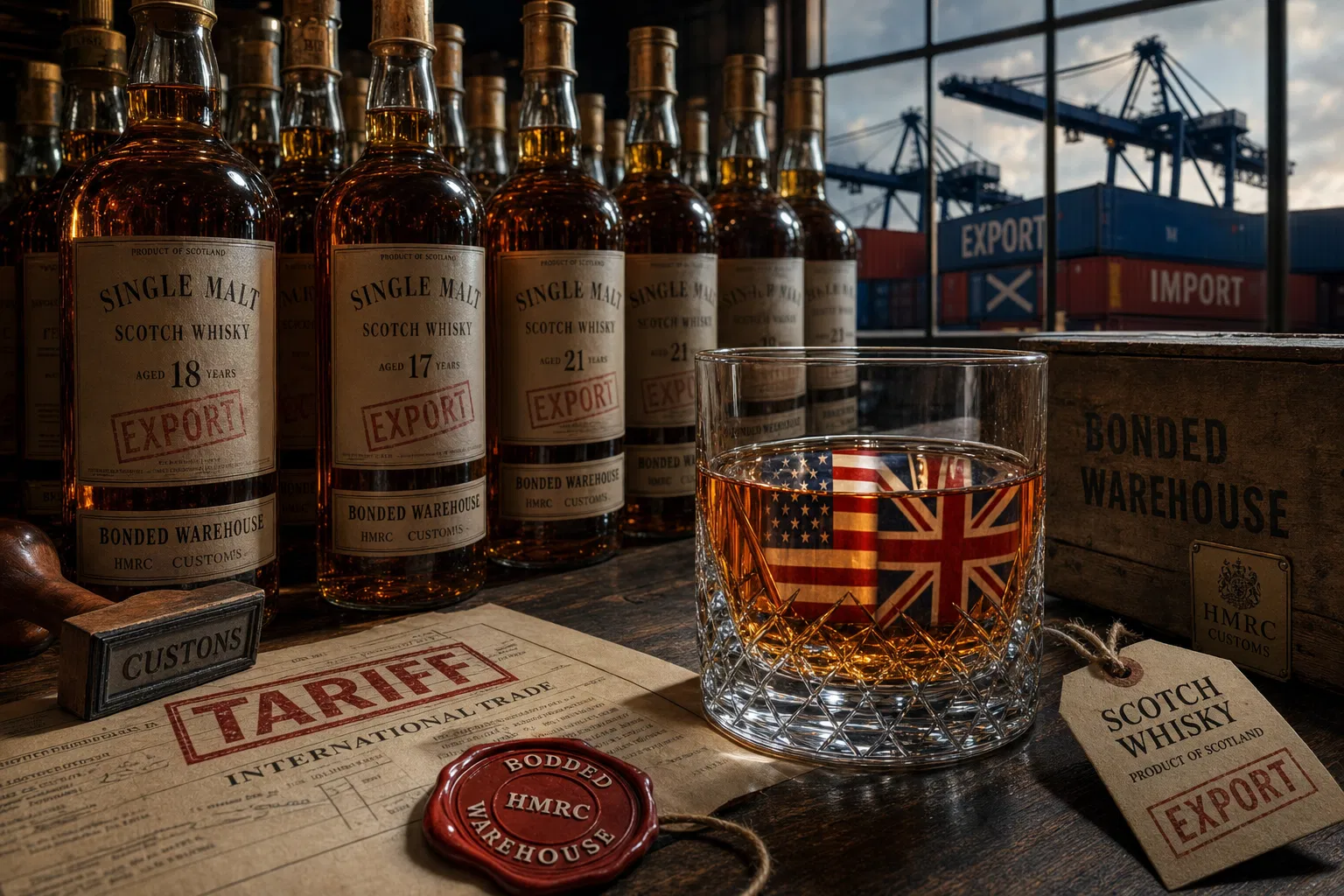
The announcement came on Truth Social, as so many things do now.
On 30 April 2026, President Donald Trump posted that he was removing the tariffs and restrictions on whisky related to Scotland's ability to work with the Commonwealth of Kentucky. He framed it as a gesture of honour to King Charles III and Queen Camilla, who had just completed a four-day state visit to the White House. "The King and Queen got me to do something that nobody else was able to do," he wrote, "without hardly even asking."
For the Scotch whisky industry, the announcement was the end of a fight that has been running, in one form or another, since October 2019. For anyone who cares about this industry, and I do, it is worth understanding exactly what happened, what it cost, and what it means going forward.
The First Tariff: October 2019
The 2019 tariff had nothing to do with whisky. It was collateral damage in a trade dispute between the United States and the European Union over aerospace subsidies. The World Trade Organization had ruled that the EU had provided illegal subsidies to Airbus, and the US was authorised to impose retaliatory tariffs on European goods. Scotch whisky, along with French wine and Italian cheese, ended up on the list.
On 18 October 2019, a 25% ad valorem tariff was applied to all Single Malt Scotch Whisky and Scotch whisky liqueurs entering the United States. The US had been Scotch whisky's most valuable export market for years, and the tariff hit immediately. Exports to the US fell 25% in the final quarter of 2019 alone.
Over the 18 months the tariff was in force, the Scotch Whisky Association (SWA) calculated that the industry lost over £600 million in exports to the United States. That is more than £1 million every single day. For an industry built on patience, on years and decades of maturation, the speed of the damage was brutal.
The tariff was paused in March 2021 and formally suspended for five years in June 2021, as part of a broader UK-US trade agreement. The industry exhaled. But the five-year clock was ticking.
The Second Tariff: April 2025
The suspension was due to expire in June 2026. Before it did, a new tariff arrived.
On 2 April 2025, the Trump administration imposed a 10% baseline tariff on most UK goods entering the United States as part of a broader set of global trade measures. Scotch whisky was caught in it. The tariff was lower than the 2019 rate, but the US market is so large that the impact was still severe.
The SWA's figures tell the story clearly. In 2025, full-year exports to the US fell 4% in value to £933 million. Volume fell more sharply, down 9.2% to the equivalent of 120 million bottles. But the acute effect of the tariff is even clearer when you isolate the period after it was imposed: between May and December 2025, export value dropped 7% and volume dropped 15%.
To put that in context, the US is Scotch whisky's most valuable export market and its third-largest by volume. The industry was losing an estimated £4 million per week, almost £20 million per month, to a tariff that had nothing to do with the quality of the product or the fairness of the trade.
Global Scotch exports in 2025 totalled £5.3 billion in value, down 1.8% on 2024, with 1.34 billion bottles shipped. The US decline was a significant factor in that slide.
The Barrel Trade: Why Kentucky Was Always Part of This
Trump's announcement specifically referenced Scotland's ability to work with the Commonwealth of Kentucky on whisky and bourbon. That is not a throwaway line. It goes to the heart of why this trade relationship matters to both sides.
Scotch distillers buy approximately £220 million worth of used bourbon barrels from Kentucky every year. This is not a small detail. It is a cornerstone of how Scotch whisky is made. The legal requirement that Scotch whisky must be matured in oak casks, combined with the preference for ex-bourbon barrels that has developed over decades, means that Scotland is Kentucky's single largest export market for used barrels.
When tariffs disrupt the flow of Scotch into the US, they also disrupt the economics of the barrel trade. When Scotch distillers are under pressure, they buy fewer barrels. When they buy fewer barrels, Kentucky cooperages and distilleries feel it. The relationship is genuinely reciprocal, which is why the Kentucky Distillers' Association (KDA) was among the most vocal advocates for removing the tariff.
Eric Gregory, president of the KDA, put it plainly: "For generations, Kentucky and Scotland have been close partners in crafting the world's most sought-after whiskies. Scotch distillers have long been the largest export market for Kentucky's used bourbon barrels."
The Kentucky bourbon industry brings nearly $10.6 billion annually to the state's economy and supports around 24,000 jobs. The barrel trade is a meaningful part of that. This was never just a Scottish problem.
What the Removal Actually Means
Mark Kent, Chief Executive of the SWA, called it "a significant boost for the Scotch Whisky industry in our most valuable export market." He said distillers could "breathe a little easier during a period of significant pressure on the sector."
That is measured language, and it is appropriate. The tariff removal is genuinely good news, but it does not erase the losses of the past year, and there are still complications.
First, the announcement was made on Truth Social and has not yet been codified in formal trade legislation. The industry will be watching closely to ensure the removal is implemented fully and permanently, not just as a diplomatic gesture that could be reversed.
Second, the five-year suspension of the original 25% single malt tariff was due to expire in June 2026. That tariff was tied to the Boeing-Airbus aerospace dispute, which has never been fully resolved. The Trump announcement appears to address both the 10% baseline tariff and the looming reinstatement of the 25% tariff, but the underlying WTO dispute remains live. The SWA and the Distilled Spirits Council of the United States (DISCUS) have been calling for a permanent resolution for years.
Third, as Martha Dalton of Never Say Die Bourbon pointed out, the tariff removal currently applies to Scotch whisky. Other UK spirits, including English whisky and gin, are still subject to the 10% tariff. Irish whiskey from the Republic of Ireland faces a 15% tariff. The job is not finished.
Why This Matters Beyond the Numbers
I have been drinking Scotch whisky for long enough to know that the industry is not just about economics. It is about communities. It is about the distilleries in Speyside and Campbeltown and the Highlands and Islay that employ local people, source local barley, and draw visitors from around the world. It is about the coopers in Kentucky who make the barrels that give Highland single malts their vanilla and caramel and dried fruit. It is about the interconnection of two great whisky traditions that have been trading with each other for generations.
When tariffs disrupt that, they do not just affect export figures. They affect investment decisions, staffing levels, distillery expansions, and the long-term confidence of an industry that operates on timescales measured in decades, not quarters.
The removal of this tariff is a genuine win. It should be acknowledged as such. But the Scotch whisky industry has been here before. It knows that trade relationships can change quickly, and that the work of protecting this industry from being used as a bargaining chip in disputes that have nothing to do with whisky is never truly finished.
For now, though, the dram tastes a little better. And that is worth raising a glass to.
The Timeline at a Glance
| Date | Event |
|---|---|
| October 2019 | 25% tariff imposed on Single Malt Scotch Whisky as part of Boeing-Airbus WTO dispute |
| March 2021 | 25% tariff paused |
| June 2021 | 25% tariff suspended for five years under UK-US trade agreement |
| April 2025 | 10% baseline tariff imposed on most UK goods, including Scotch whisky |
| May-Dec 2025 | US Scotch export volumes fall 15%, value falls 7% |
| February 2026 | SWA reports full-year 2025 US exports down 9.2% in volume, 4% in value to £933m |
| 30 April 2026 | President Trump announces removal of all tariffs on Scotch whisky following King Charles III state visit |
What to Watch Next
The industry will be focused on three things in the coming months. First, the formal implementation of the tariff removal in US trade law. Second, the resolution of the Boeing-Airbus dispute that created the original 25% tariff exposure. Third, whether the zero-for-zero tariff framework can be extended to other UK spirits and to Irish whiskey, completing the job that this announcement started.
For those of us who love Scotch whisky, who visit the distilleries, who understand the craft and the history and the extraordinary care that goes into every bottle, this is a moment to appreciate. The industry fought hard for this. It deserved to win.
Frequently Asked Questions
What were the US tariffs on Scotch whisky?
The US first imposed a 25% tariff on single malt Scotch whisky in October 2019, as part of a retaliatory measure in the long-running Boeing-Airbus trade dispute between the US and the EU. The UK was caught in the crossfire despite not being a party to the original dispute. The tariff was paused in March 2021 and then suspended for five years in June 2021 under a UK-US trade agreement. In April 2025, a new 10% baseline tariff was imposed on most UK goods including Scotch whisky as part of the Trump administration's broad tariff programme. That tariff was removed on 30 April 2026 following the King Charles III state visit to Washington.
How much did US tariffs cost the Scotch whisky industry?
The Scotch Whisky Association estimated that the original 25% tariff cost the industry over £600 million in lost exports between October 2019 and June 2021. US exports fell by 35% in volume during the peak tariff period. The 2025 10% tariff caused a further 9.2% decline in US export volumes for the full year, with the value of US exports falling to £933 million. The US is the single most important export market for Scotch whisky by value, making tariff exposure there particularly damaging.
Why did Trump remove the Scotch whisky tariffs?
President Trump announced the removal on 30 April 2026, framing it as a personal gesture to King Charles III and Queen Camilla following their four-day state visit to Washington. Trump stated that the King and Queen had persuaded him to act. The announcement also referenced the importance of Kentucky bourbon barrel exports to Scotland, which are central to Scotch whisky maturation. The removal was part of a broader zero-for-zero tariff framework being negotiated between the UK and US governments.
What does the tariff removal mean for Scotch whisky prices?
In theory, the removal of the 10% tariff should reduce the cost of Scotch whisky for American consumers by a corresponding amount, assuming retailers and importers pass the saving on. In practice, pricing adjustments in the spirits market tend to be gradual. The more significant impact will be on export volumes, as US distributors and retailers rebuild inventory levels that were deliberately kept low during the tariff uncertainty. The industry expects a meaningful recovery in US export volumes over the 12 to 18 months following the announcement.
Is Irish whiskey also affected by US tariffs?
Irish whiskey was not subject to the original 25% tariff because it was not part of the Boeing-Airbus dispute, which targeted EU and UK goods. Irish whiskey did face the 10% baseline tariff imposed in April 2025, which affected all UK and EU goods entering the US. The zero-for-zero framework announced in April 2026 specifically referenced Scotch whisky, and the industry is watching closely to see whether the same terms will be extended to Irish whiskey and other UK spirits.
Where can I track Scotch whisky export data?
The Scotch Whisky Association publishes quarterly and annual export statistics on its website, broken down by market, category, and value. The SWA's annual report is the most comprehensive source of data on the industry's global performance. HMRC also publishes UK trade statistics that include Scotch whisky export volumes and values. For real-time news on tariffs and trade policy affecting the industry, the SWA's news section and the Cask-It™ journal are both reliable sources.